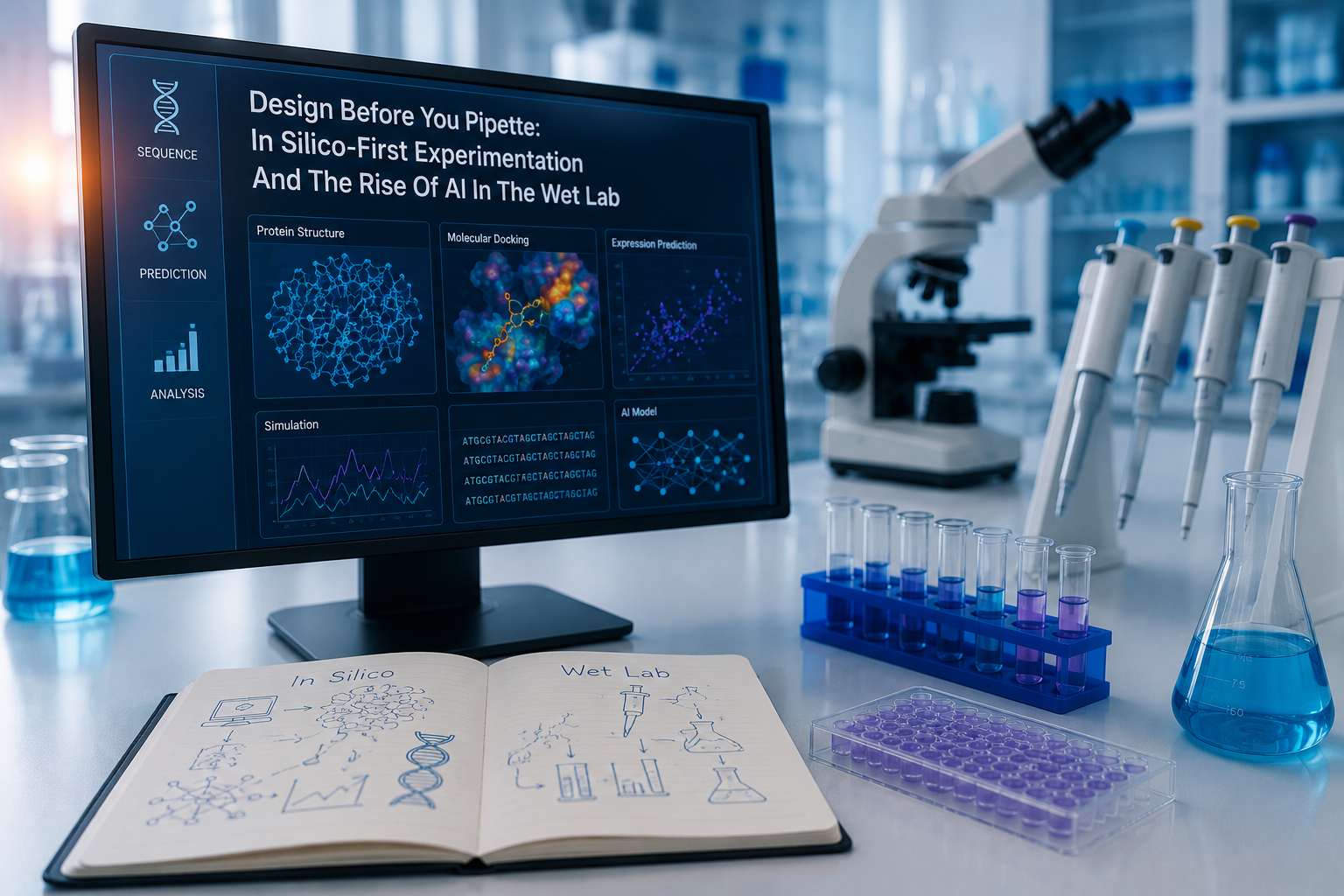
Liquid Biopsy And The Limits Of Detection: Quantifying Ctdna By Digital Pcr
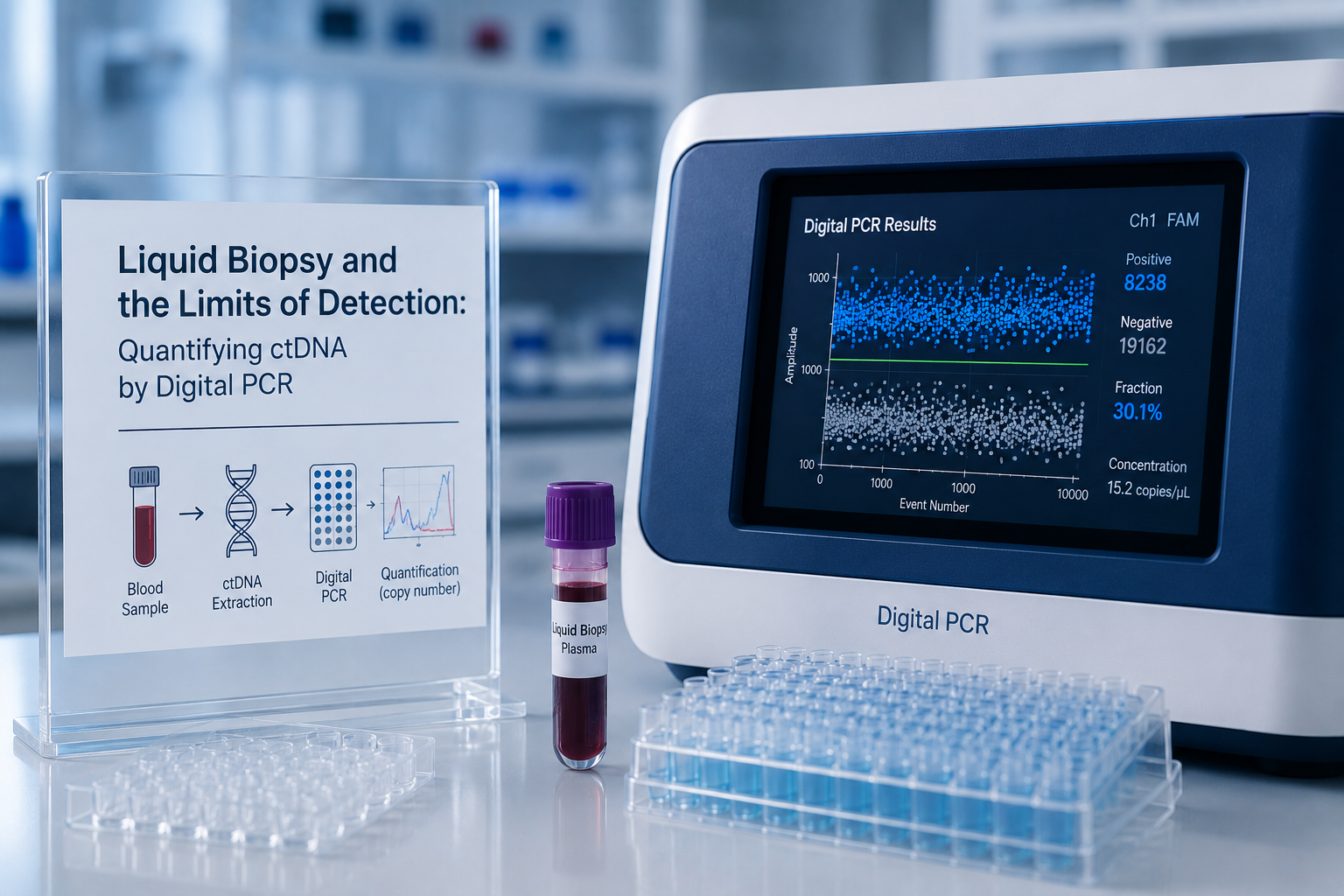
Liquid biopsy reframes a tumor as something readable from plasma. Dying tumor cells release fragmented DNA into the circulation; this circulating tumor DNA (ctDNA) is a minority signal within a far larger pool of non-tumor cell-free DNA (cfDNA), so the analytical challenge is detecting a rare variant against an overwhelming wild-type background. The metric that governs the field is the variant allele frequency (VAF) — the proportion of mutant to total alleles — and how low it can be reliably called.
Digital PCR is the method built for that regime. By partitioning a sample into thousands of nanolitre reactions and scoring each as positive or negative, droplet digital PCR (ddPCR) converts amplification into an absolute, Poisson-corrected count rather than a relative Ct value. This partitioning raises sensitivity 10–100× over conventional qPCR, whose practical floor sits around 1–5% VAF. Digital platforms reliably resolve VAFs in the 0.1%–0.01% range, and optimized ddPCR assays have reported mutant allele detection as low as ~0.001%—on the order of a single mutant molecule among tens of thousands of wild-type copies. The trade-off is scope: dPCR interrogates a predefined set of mutations with high precision, whereas next-generation sequencing trades some sensitivity for breadth across known and novel variants.
Why this matters at the bench and the clinic:
Quantitative, longitudinal monitoring—absolute counts allow serial, non-invasive sampling to track tumor evolution and therapeutic response rather than relying on a single snapshot.
Early molecular relapse — ctDNA-based minimal residual disease (MRD) signals can precede radiological recurrence; reported lead times reach several months, with one analysis noting molecular relapse on average roughly nine months before clinical relapse.
Pre-analytical rigor—because the target is so rare, results hinge on standardized collection, plasma separation timing, and extraction; pre-analytical error, not assay chemistry, is the usual cause of irreproducibility.
The competency that unlocks liquid biopsy is therefore not a single instrument but a chain: disciplined sample handling, validated assay design with defined limits of detection, and correct statistical interpretation of low-count data. Each link is a teachable, reproducible skill.
Arep Academy’s molecular techniques track covers cfDNA workflows end-to-end — pre-analytical control, ddPCR partitioning and Poisson quantification, and LOD-aware interpretation.