Design Before You Pipette: In Silico-First Experimentation And The Rise Of Ai In The Wet Lab
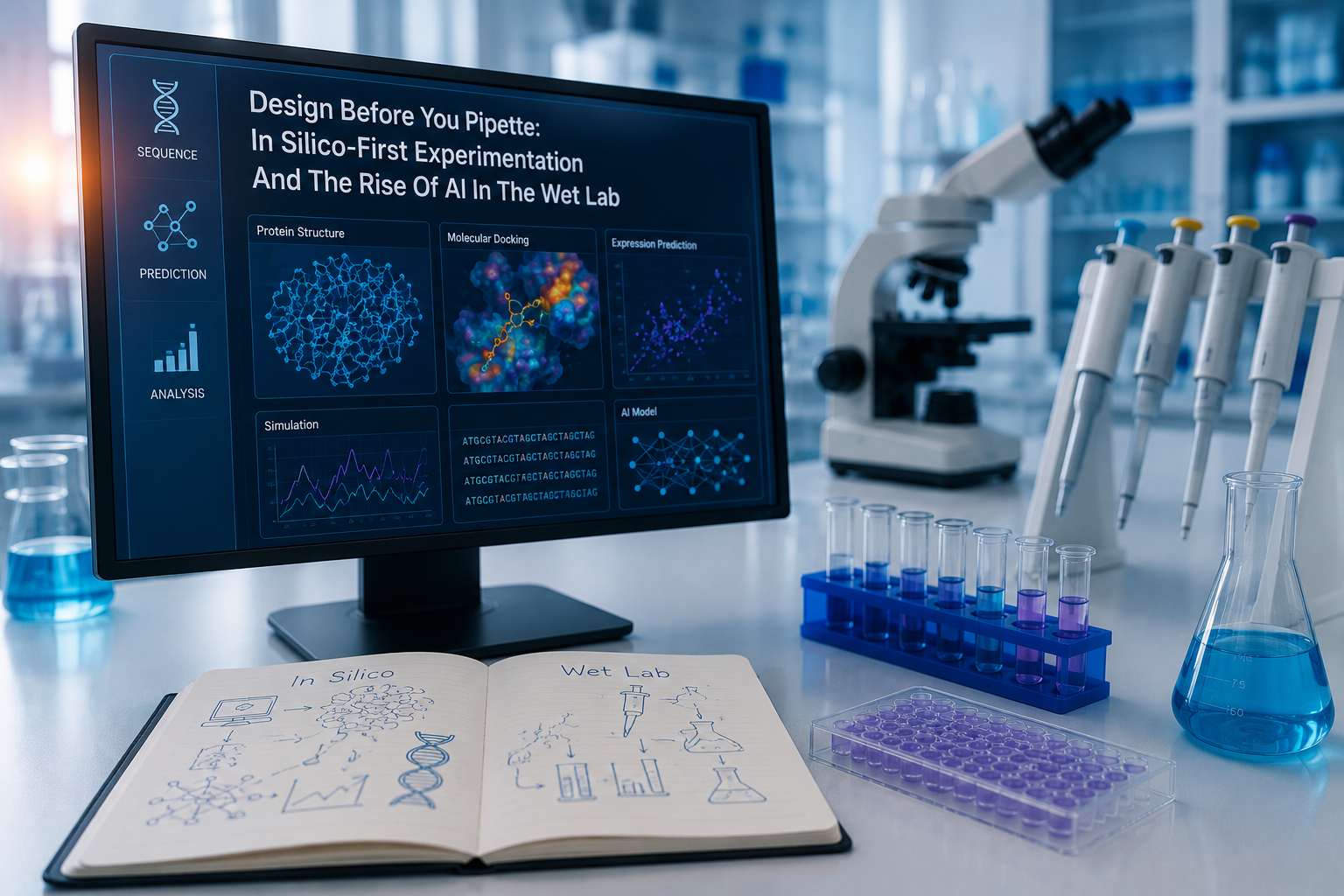
In preclinical research, attrition is the dominant cost. The majority of candidate molecules that enter development never reach approval, and a large share of that failure traces back to the earliest decisions: an underpowered design, a poorly chosen target, or a model system that does not recapitulate the biology of interest. The emerging response is methodological rather than instrumental—shifting decision-making upstream, into a computational (in silico) phase that precedes any bench validation.
In this paradigm, AI-guided platforms integrate genomic, transcriptomic, and proteomic datasets to identify and prioritize targets before wet-lab work begins, surfacing disease-driving pathways that remain hidden when datasets are analyzed in isolation. Structure prediction and generative models then inform candidate design, while the predicted outcomes are ranked so that only the highest-value experiments consume reagents and time. The downstream effect is a measurable compression of discovery timelines: in one widely cited case, an AI-driven pipeline reduced preclinical development for a fibrosis candidate from roughly six years to thirty months, and the first fully AI-discovered drug candidates have now entered clinical evaluation.
For the practicing scientist, the discipline this demands is threefold:
Hypothesis generation — multi-omic integration identifies target–disease associations and candidate mechanisms that a manual literature review would not surface, sharpening the experimental question before design.
Design optimization — power, controls, confounders, and assay parameters can be evaluated against in silico models prior to sample preparation, reducing avoidable false negatives.
Validation hierarchy — computational prediction does not replace empirical confirmation; it reallocates effort toward experiments most likely to validate, keeping human judgment over decisions that affect safety and interpretation.
The defensible position is integration, not substitution: AI moves the analytical burden upstream, where errors are cheap to correct, but the wet-lab validation, the controls, and the interpretation remain the scientist’s. The laboratories that compound an advantage in 2026 are those that treat experimental design as a computational problem first and a manual one second.
Arep Academy’s Experimental Design track teaches this workflow end-to-end — from multi-omic framing of a question to power-justified, model-informed protocols.