
From Monolayer To Microtissue: Patient-Derived Organoids As Predictive Models
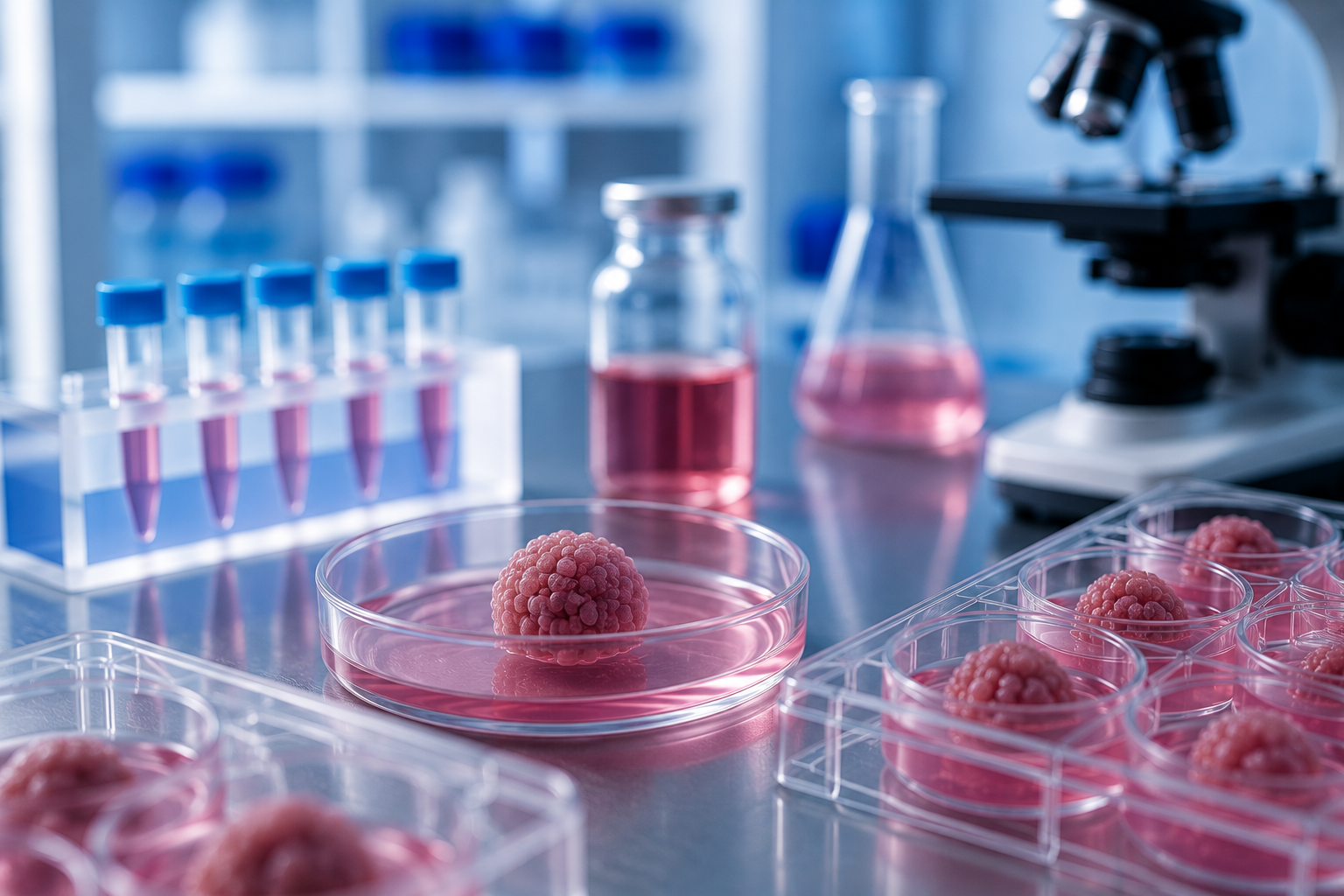
Conventional 2D culture grows immortalized cell lines as a flat monolayer on plastic. The format is convenient but biologically impoverished: it loses three-dimensional architecture, cell–cell and cell–matrix signaling, and the oxygen and nutrient gradients of real tissue. That gap is one reason the great majority of anti-cancer candidates that succeed preclinically still fail in trials—the model does not behave like the disease.
Patient-derived organoids (PDOs) are the structural correction. Grown from a patient’s own surgically resected or biopsied tumor cells into self-organizing 3D microtissues, they retain the molecular identity of the parent tumor with high fidelity: studies report mutational (SNV) concordance of roughly 90–96% with the originating tissue, along with preserved DNA methylation and gene-expression signatures. Functionally, what matters is whether a PDO’s drug response predicts the patient’s. A systematic review and meta-analysis of 411 patient–model pairs found overall treatment-response concordance of about 70%, comparable to patient-derived xenografts but with lower cost and ethical burden; individual prospective studies report sensitivity and specificity in the ~75–92% range, and patients whose matched PDO responded showed prolonged progression-free survival.
What this means for the experimenter:
More predictive screens—compounds are tested against tissue-like structures with quantitative readouts (cell-viability AUC, IC50/GR50), improving translational odds versus flat monolayers.
Patient-relevant biology—PDOs can be derived to mirror a specific tumor, supporting functional precision oncology and biomarker discovery rather than population-average assumptions.
New, non-trivial technique demands: establishment is not guaranteed (reported success rates commonly ~50–75%), and culturing, maintaining, and imaging 3D structures require skills distinct from 2D work, with standardized protocols now being formalized by expert consensus.
The 2D→3D shift is a clear case where changing the method improves the quality of the underlying science rather than merely its throughput. For anyone running cell-based assays, organoid competency is moving from niche specialization to core skill—and the limiting factor is increasingly reproducible technique, not access to the model.
Arep Academy’s lab-simulation modules build hands-on fluency with 3D culture establishment, maintenance, and quantitative drug-sensitivity readouts.